What to Eat in Ubon Ratchathani: A First-Timer's Flavor Map
Information last verified 29 August 2026.
Ubon food makes more sense as a map of meals than as a “top ten” list. Begin with the city’s rice-noodle culture, add preserved pork products linked to local and Vietnamese-Thai foodways, learn how an Isan shared meal balances textures and heat, and then let markets and season decide the details.
This guide does not rank restaurants. Businesses, stalls, menus, and hygiene conditions change; the dishes and ordering logic are more durable.
Start with a bowl: guay jub Ubon
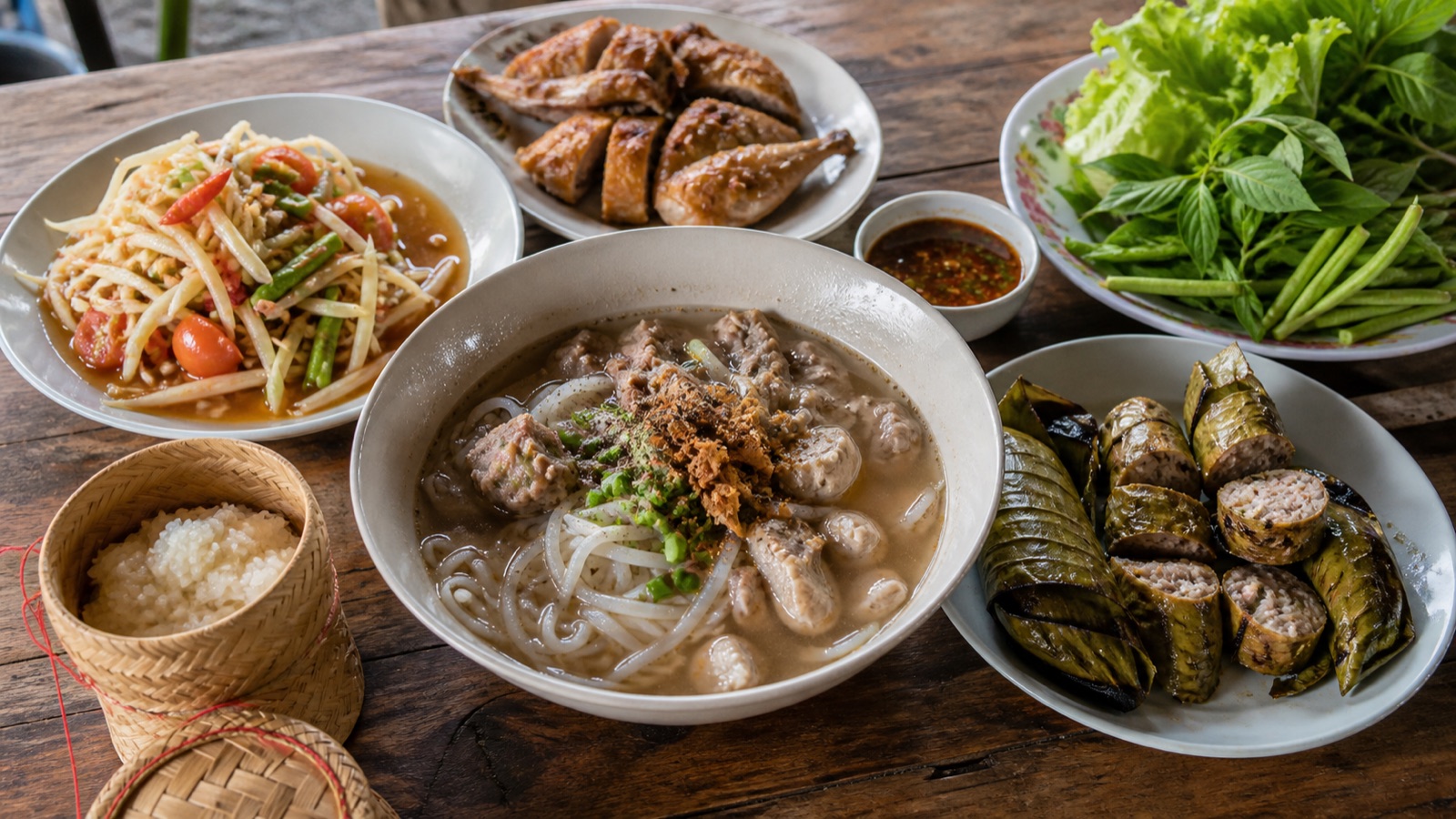
Guay jub Ubon (กวยจั๊บอุบล), also called guay jub yuan (กวยจั๊บญวน) or khao piak sen in related Lao usage, is the city’s defining noodle conversation. Ubon Ratchathani University traces the local form to Vietnamese migration and subsequent local production and adoption.
Expect rice-flour noodles in a hot, often slightly thickened broth. Toppings vary by shop: pork, ribs, minced pork, egg, fried shallot, spring onion, and slices of moo yor may appear. The word yuan historically points to Vietnam, but the two menu names do not guarantee two standardized recipes. The focused guay jub guide explains how to order.
Learn the preserved-pork family
Ubon’s official tourism page highlights moo yor, kun chiang, and Isan sausage among local food souvenirs.
- Moo yor is a smooth, springy pork product seasoned prominently with pepper in many versions. It can appear in noodle soup, salad, fried dishes, or slices.
- Kun chiang is a sweet cured Chinese-style sausage, usually cooked before eating.
- Sai krok Isan is a tangy fermented sausage commonly associated with pork and rice.
- Naem is fermented meat sold in several forms and used in cooked or ready-to-eat dishes.
These are distinct processes, not four names for the same sausage. Storage differs by product and process. Read the package’s current storage direction and use-by date; vacuum packing alone does not establish room-temperature stability. Ask the seller how each product should travel before buying gifts.
Build one shared Isan meal
A balanced table might combine som tam for acidity and heat, larb or another minced dish, grilled chicken or fish, a soup or curry, fresh vegetables and herbs, and sticky rice. This is a shared ordering structure, not a mandatory set.
Ask how spicy a dish is and whether it contains fermented fish sauce (pla ra), fish sauce, shrimp paste, stock, offal, raw meat, or allergens. “Mai phet” can reduce chilli but does not remove fermented ingredients. Never assume a vegetable dish is vegetarian.
Choose fully cooked pork. Thailand’s Department of Disease Control warns against raw pork, raw-blood larb, raw naem, and undercooked grilled pork because of Streptococcus suis risk. Lime juice does not cook meat safely.
Sticky rice is both food and tool
Pinch a small portion of khao niao (ข้าวเหนียว), shape it with clean fingers, and use it to gather a bite or absorb sauce. Do not knead the entire basket or return touched rice. The ventilated bamboo kratip helps keep steamed rice warm without trapping enough condensation to make it soggy.
Let river and season add—not define—the menu
The Mun and Mekong support food traditions, but a menu’s “river fish” claim needs a species, source, and season. Ask whether fish is wild-caught or farmed and avoid protected wildlife. The biggest or rarest fish is not automatically the best choice.
Rainy-season mushrooms, bamboo shoots, herbs, young rice, and other produce can reshape local menus. Never eat an unidentified wild mushroom on a seller’s verbal assurance alone; choose established vendors and cooked preparations.
Plan three food windows
Use one morning for a market and breakfast, one midday for guay jub or a rice meal, and one evening for a shared Isan table or a street-food walk. This is more realistic than eating five rich “specialities” in succession. Morning markets reveal ingredients; evening vendors show prepared food and snack culture.
Check before eating — last verified 29 August 2026: This article verifies dish context, not any vendor’s current hygiene, hours, or menu. Look for clean preparation, protected food, separate raw and cooked utensils, hot food served hot, and local SAN or equivalent hygiene signage where displayed.
Ubon’s food is not a contest to consume the most unusual ingredient. Ask, compare, share, and credit the Vietnamese, Chinese, Lao-Isan, Thai, rural, and urban threads without forcing every dish into a single origin story.
